LANDSTAR SYSTEM (LSTR)·Q4 2025 Earnings Summary
Landstar Q4 Earnings Crushed by $56M Insurance Costs; Stock Slides After Hours
January 28, 2026 · by Fintool AI Agent
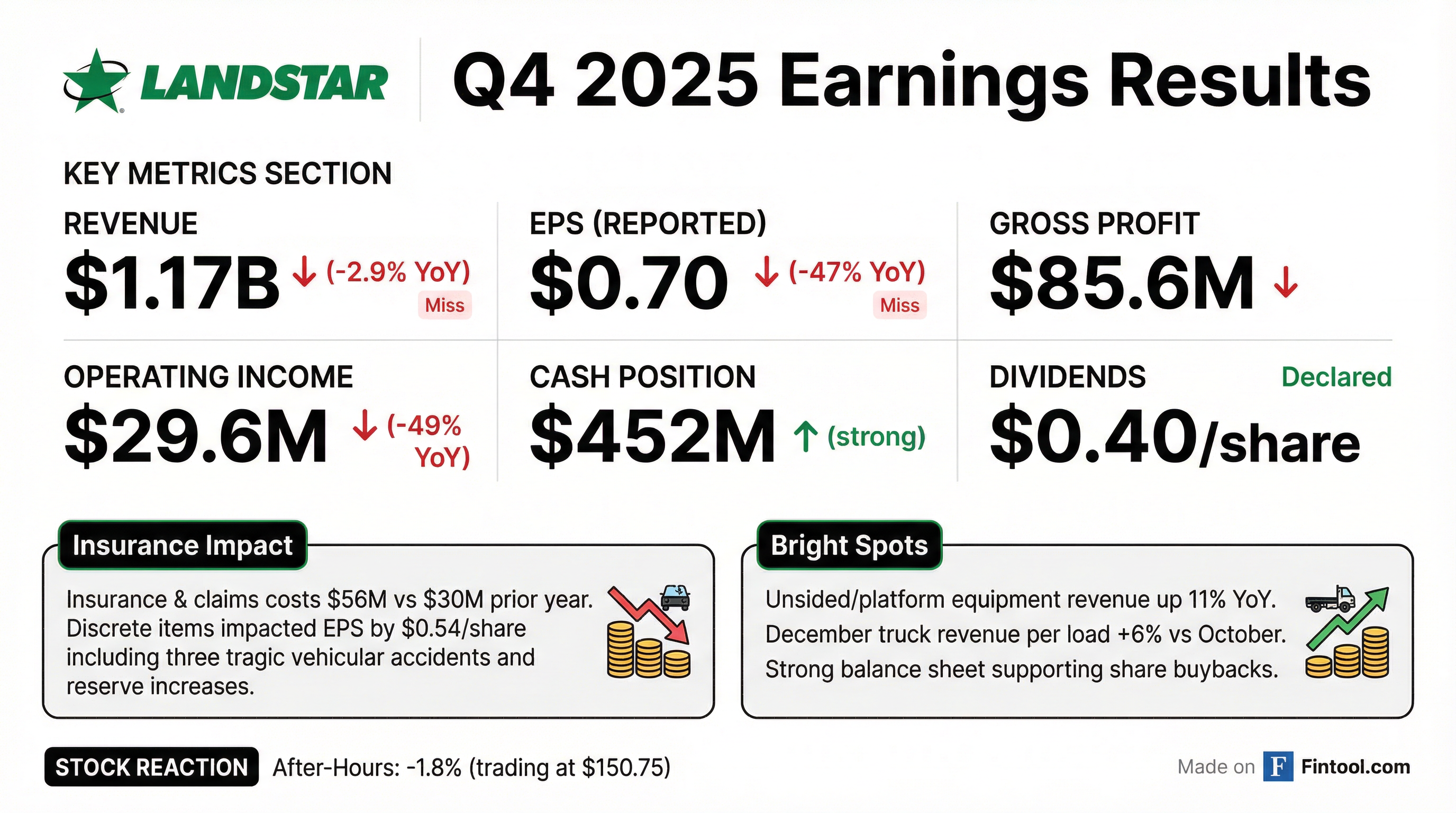
Landstar System (NASDAQ: LSTR) delivered a disappointing Q4 2025, with EPS plunging 47% year-over-year to $0.70 as insurance and claims costs nearly doubled. While the asset-light trucking company's core operations showed resilience with truck revenue nearly flat YoY, a brutal claims environment and discrete charges obliterated profitability. Shares fell approximately 1.8% in after-hours trading following the release.
Did Landstar Beat Earnings?
No. Landstar missed on both top and bottom lines:
The headline EPS miss is misleading without context. Insurance and claims costs soared to $56 million—up from approximately $30 million in Q4 2024—creating a $0.54/share headwind from discrete items.
On an adjusted basis (excluding discrete insurance items), EPS would have been approximately $1.24, roughly in line with consensus. But reported is reported, and the market reacted accordingly.
 Ask Fintool AI Agent
What Drove the Insurance Surge?
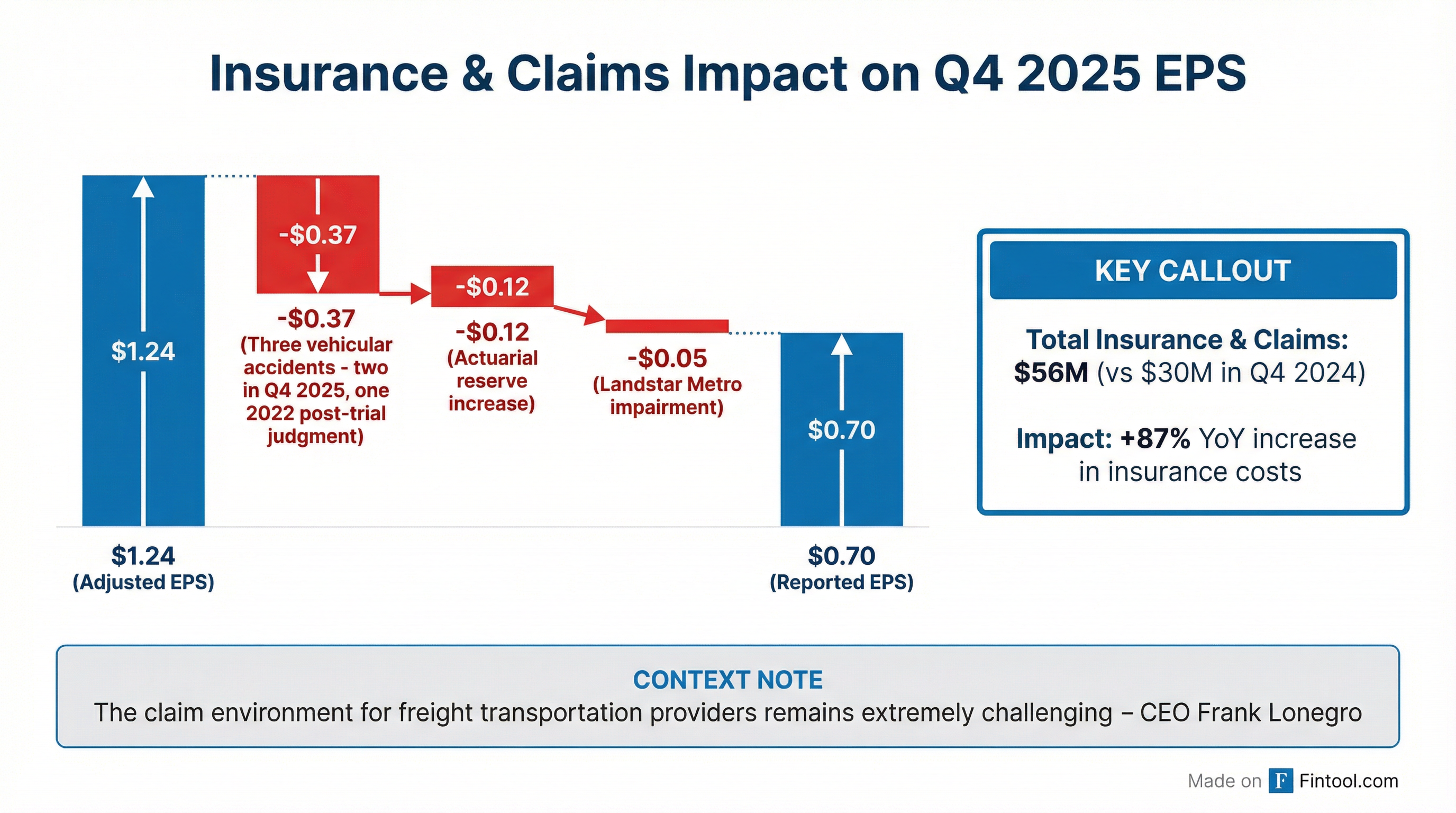
CEO Frank Lonegro was direct: "The claim environment for freight transportation providers remains extremely challenging."
The Q4 2025 insurance and claims breakdown:
Insurance and claims for the full year hit $159 million, up 40% from $114 million in FY 2024. This wasn't a one-quarter blip—it's a structural headwind facing the entire trucking industry.
What Worked in Q4?
Despite the insurance headwinds, Landstar's core network performed well:
Heavy Haul Record: Landstar's heavy haul service offering posted a 23% YoY revenue increase to approximately $170 million in Q4 2025, driven by 16% higher revenue per load and 7% volume growth. For the full fiscal year, heavy haul hit a record $569 million—approximately 14% above 2024's previous record.
Unsided/Platform Equipment: Revenue grew 11% YoY to $401 million, continuing a bright spot trend throughout 2025. Heavy haul revenue as a percentage of the unsided category increased from 38% in Q4 2024 to 42% in Q4 2025.
Pricing Power: Truck revenue per load increased 1% YoY, with December showing particular strength—up 6% from October, outperforming pre-pandemic historical seasonality.
Van Equipment Pressure: Revenue declined 6% YoY to $559 million, reflecting continued tough macro demand conditions in the freight market.
The ocean and air cargo decline (-28% YoY) was the primary driver of the overall revenue miss—truck transportation was essentially flat.
Industry Revenue Mix
Landstar's revenue by industry served shows concentration in consumer durables and machinery, with notable shifts in Q4:
The machinery segment was a bright spot, growing 14% YoY and increasing its revenue share to 16.1%. Combined with the platform equipment outperformance, this suggests Landstar is gaining traction in heavier industrial freight while consumer-facing segments remain soft.
How Is the Balance Sheet?
Strong. Landstar ended Q4 with $452 million in cash and short-term investments.
Capital Return: The company repurchased 286,695 shares for $37 million in Q4, bringing full-year buybacks to 1.28 million shares at $181 million. Another 1.27 million shares remain authorized.
Dividend: Declared $0.40/share quarterly dividend payable March 11, 2026.
The ROE compression (13% vs 20% YoY) reflects the earnings pressure from insurance costs, not balance sheet deterioration.
Ask Fintool AI AgentHow Did the Stock React?
Landstar closed regular trading at $153.51, up 1.2% on the day. However, shares fell to $150.75 in after-hours trading, down approximately 1.8% from the close, as investors digested the earnings miss.
The muted after-hours reaction may reflect that Landstar pre-announced these results on January 21, 2026, giving the market time to adjust expectations.
What Did Management Guide?
Landstar doesn't provide formal guidance, but CEO Lonegro offered color on January 2026 trends:
January 2026 Business Activity:
- Truck loads: Approximately 1% below January 2025
- Truck revenue per load: Approximately 4% above January 2025
Historical Seasonality (pre-pandemic patterns suggest for Q1):
- Truck revenue: Mid-to-high single digit decline Q4→Q1
- Truck loads: 4% decline Q4→Q1
- Truck revenue per load: 4% decline Q4→Q1
The January data shows loads tracking slightly below but pricing tracking above historical norms—a constructive signal for the near term.
Variable Contribution Margin: Typically expands 40-60 basis points from Q4 to Q1, driven by increased BCO mix. However, winter storm activity could negatively impact Q1 BCO utilization.
Tariff Comparison Challenge: Management noted Q1 2025 truck volumes exceeded Q4 2024 for the first time in 15 years, likely driven by tariff pull-forward behavior, creating a tough YoY comp.
What's Landstar Investing In?
Management highlighted AI as a key focus, with AI-related projects accounting for half of the 2026 IT capital budget:
The AI strategy has two tracks—tools for the agent/BCO network and corporate operations:
AI for the Landstar Network of Entrepreneurs:
AI for Landstar Corporate:
The strategy targets three outcomes: (1) unlock agent/BCO growth and raise revenue thresholds, (2) strengthen retention, and (3) minimize risk and reduce friction across the network.
Management emphasized this is an evolutionary, not experimental strategy—building on the "Landstar 2020" digital transformation foundation laid since 2016. A dedicated AI task force will work with "agentic AI startups" and established technology partners beginning in Q1 2026.
2026 Expense Outlook
CFO Jim Todd provided detailed expense guidance for 2026:
Management noted they will "endeavor to offset as much of that as possible" through operational efficiencies and trailer disposal gains.
What Changed From Last Quarter?
The sequential operating income collapse was entirely driven by insurance costs. Variable contribution margin held steady at 14.1%, indicating core pricing discipline remained intact.
BCO Network Improving
Despite the challenging rate environment, Landstar's BCO (Business Capacity Owner) metrics showed notable improvement:
This marks eight consecutive quarters of turnover improvement, with the rate declining from a peak of 41% in Q4 2023 to 31.4%—approaching the long-term average of 29%.
On the recruiting front, gross truck adds were up 8.9% YoY while gross cancels fell 5.1% YoY. CFO Jim Todd noted: "The additions are still coming in better than expected... I feel good about the model and the attraction of BCOs to the model."
Q&A Highlights
Winter Storm Impact: Management estimated that winter storms in late January knocked down 5,000-6,000 dispatched loads. However, unlike dedicated carriers, Landstar tends to "gap back up when the weather eventually clears."
Million-Dollar Agents: The agent count declined, with 37 agents falling just below the $1 million threshold—but retention within the million-dollar agent network remains "extremely high," with turnover at just over 1%.
AI Differentiation: CEO Lonegro contrasted Landstar's AI approach with C.H. Robinson's: "The AI for us is a little bit different... We've got 10% of the employee base that Robinson does. So they're certainly going to see it in the cost line. But what we're going to do is enable the agent offices to go out there and work smarter and faster."
DOT Regulatory Tailwinds: Management highlighted cumulative effects of DOT enforcement—English language proficiency requirements, non-domiciled CDL crackdowns, and CDL mill closures—as supportive of supply dynamics.
Data Center Demand: The data center ecosystem continued to provide "real benefits" for Landstar, helping both van and platform segments.
Ask Fintool AI AgentKey Risks to Watch
-
Insurance Environment: Management explicitly flagged this as "extremely challenging" with no near-term relief in sight. Insurance and claims in Q4 2025 included $9.2 million of unfavorable prior year development vs. just $2.2 million in Q4 2024.
-
Macro Freight Demand: "Continued tough macro demand conditions" persist in trucking
-
Capacity Attrition: BCO independent contractors declined to 7,712 (down from 8,082 YoY); active truck brokerage carriers fell to 36,852 from 43,718
-
Landstar Metro: Ongoing sale process of Mexican subsidiary with additional impairment risk
Ask Fintool AI Agent5-Year Capital Allocation Track Record
Despite the challenging 2025, Landstar's long-term capital allocation discipline remains strong:
Key observations:
- Share count reduced by 10% over 5 years through consistent buybacks
- Cumulative returns to shareholders: $1.4B+ in buybacks and dividends since 2021
- FCF declined from 2022 peak alongside freight market normalization
The company also maintained an industry-leading safety record, with DOT accident frequency holding at 0.59 accidents per million miles—flat with 2024 and down from 0.65 in 2021.
The Bottom Line
Landstar's Q4 2025 was a tale of two stories: solid operational execution (flat truck revenue, strong platform equipment, improving pricing) undermined by runaway insurance costs. The 87% YoY surge in insurance and claims created $0.54/share of noise that masked underlying business health.
For investors, the key question is whether the claims environment is cyclical or structural. Management's tone suggests the latter. Until insurance costs normalize—or Landstar finds a way to mitigate them—expect continued earnings volatility even as the core freight business stabilizes.
The strong balance sheet ($452M cash) and disciplined capital returns ($181M in buybacks + growing dividend) provide downside support, but the stock will likely remain range-bound until insurance headwinds abate.
This article incorporates information from Landstar's Q4 2025 earnings call held January 28, 2026. The full transcript and 8-K filing are available on Fintool.